Goju-Ryu (剛柔流), meaning "hard-soft style," is one of the major traditional styles of Okinawan karate. It blends powerful linear techniques with graceful circular movements, creating a dynamic and balanced martial art. Here's how it evolved:
Origins in China and Okinawa
Goju-Ryu traces its roots to Southern Chinese martial arts, especially the Fujian White Crane style and other Shaolin-based systems.
These techniques were introduced to Okinawa through trade and cultural exchange, influencing the local Naha-te style.
Founder: Chōjun Miyagi
Chōjun Miyagi (1888–1953), a student of Kanryo Higaonna, formalized Goju-Ryu in the 1930s.
Miyagi traveled to China to deepen his martial arts knowledge and synthesized hard (go) and soft (ju) techniques into a cohesive system.
He named the style "Goju-Ryu" after a line in a classical martial arts text: “The way of inhaling and exhaling is hardness and softness.”
Philosophy and Techniques
Hard techniques: punches, kicks, and blocks using strength and direct force.
Soft techniques: circular movements, joint locks, throws, and breathing control.
The style emphasizes kata (forms) like Sanchin and Tensho, which embody its internal and external principles.
Global Expansion
After Miyagi’s death, his students—such as Eiichi Miyazato and Meitoku Yagi—continued to spread Goju-Ryu worldwide.
Organizations like the International Okinawan Goju-Ryu Karate-do Federation (IOGKF) helped standardize and promote the style internationally.
Goju-Ryu remains one of the most respected karate styles, known for its depth, discipline, and spiritual focus.
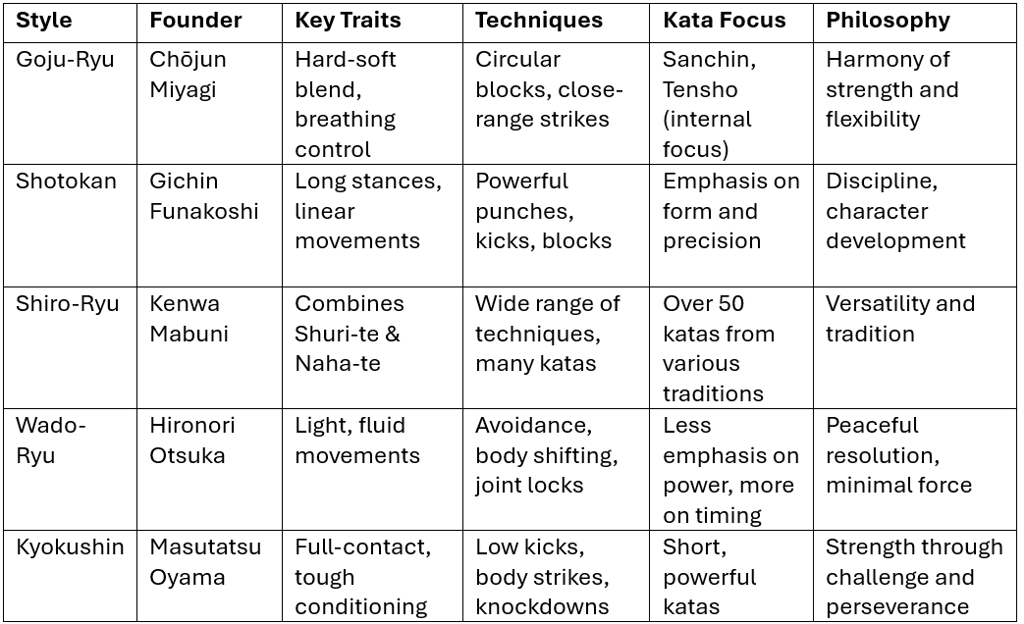
Differences Between Major Karate Styles
Karate has evolved into several distinct styles, each with its own philosophy, techniques, and training methods. Here's a comparison of the most prominent styles:
History of Goju-Ryu Karate
Key Differences
Philosophy: Shotokan emphasizes character and discipline; Goju-Ryu seeks balance; Kyokushin values toughness and realism.
Technique: Shotokan uses long, deep stances; Wado-Ryu favors evasion and fluidity; Kyokushin trains for full-contact combat.
Kata: Shito-Ryu has the most diverse kata library; Goju-Ryu’s katas focus on breathing and internal energy.
Each style offers a unique path depending on your goals—whether it's self-defense, sport, personal growth, or traditional practice.